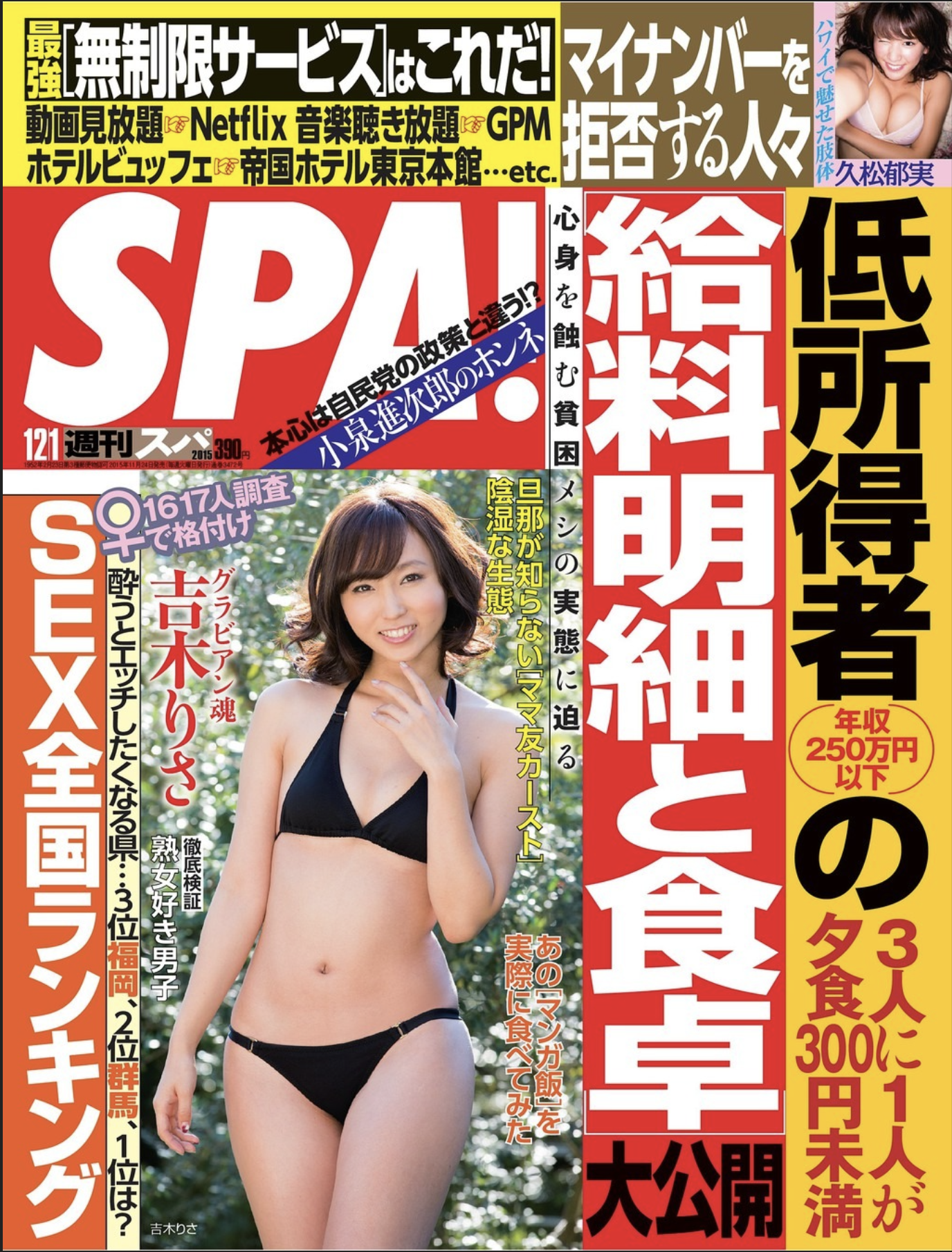
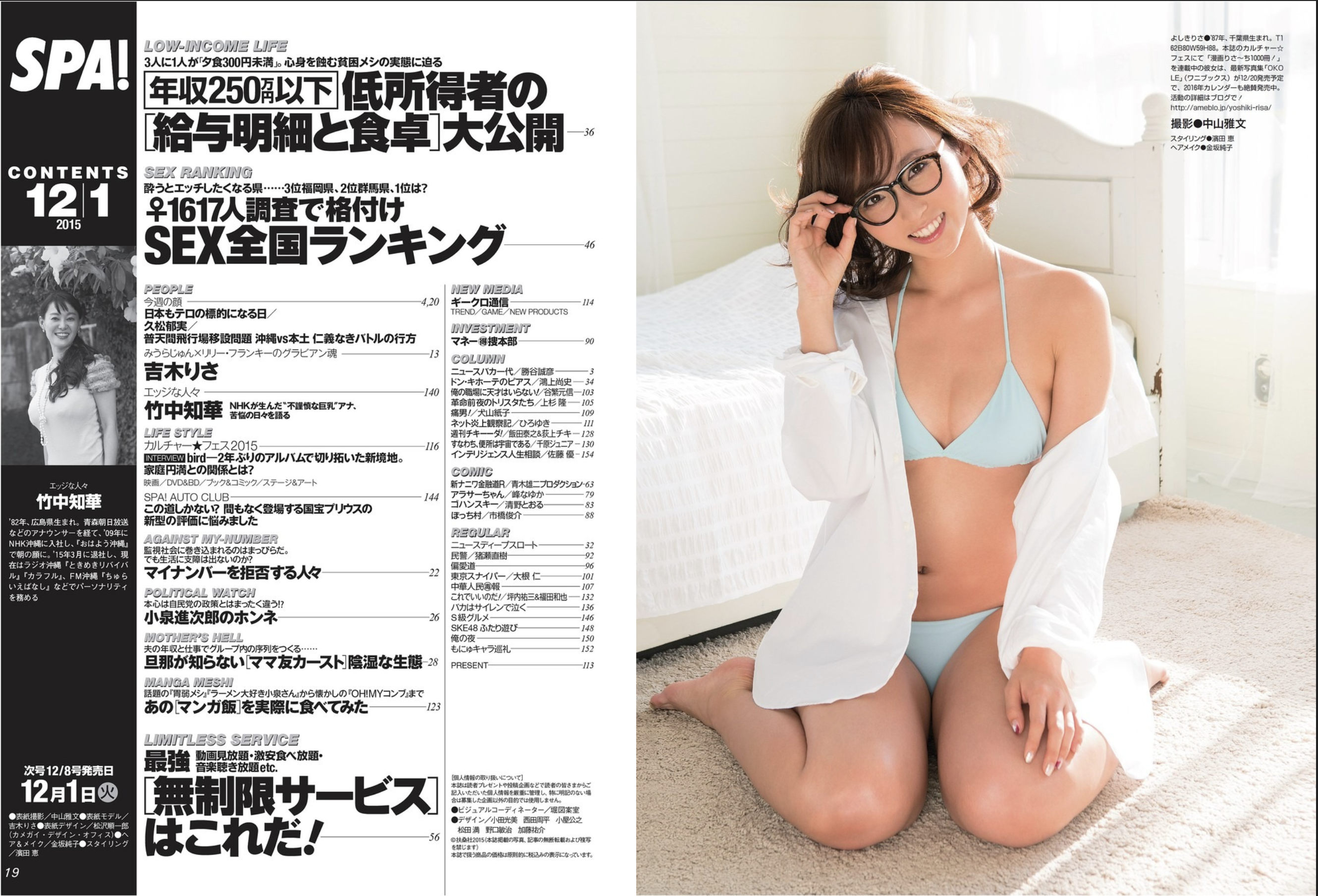
SPA! Magazine – December 2015
Born from NHK. 'Inappropriate' Big-Breasted Announcer Tomoka Takenaka speaks about her days of anguish
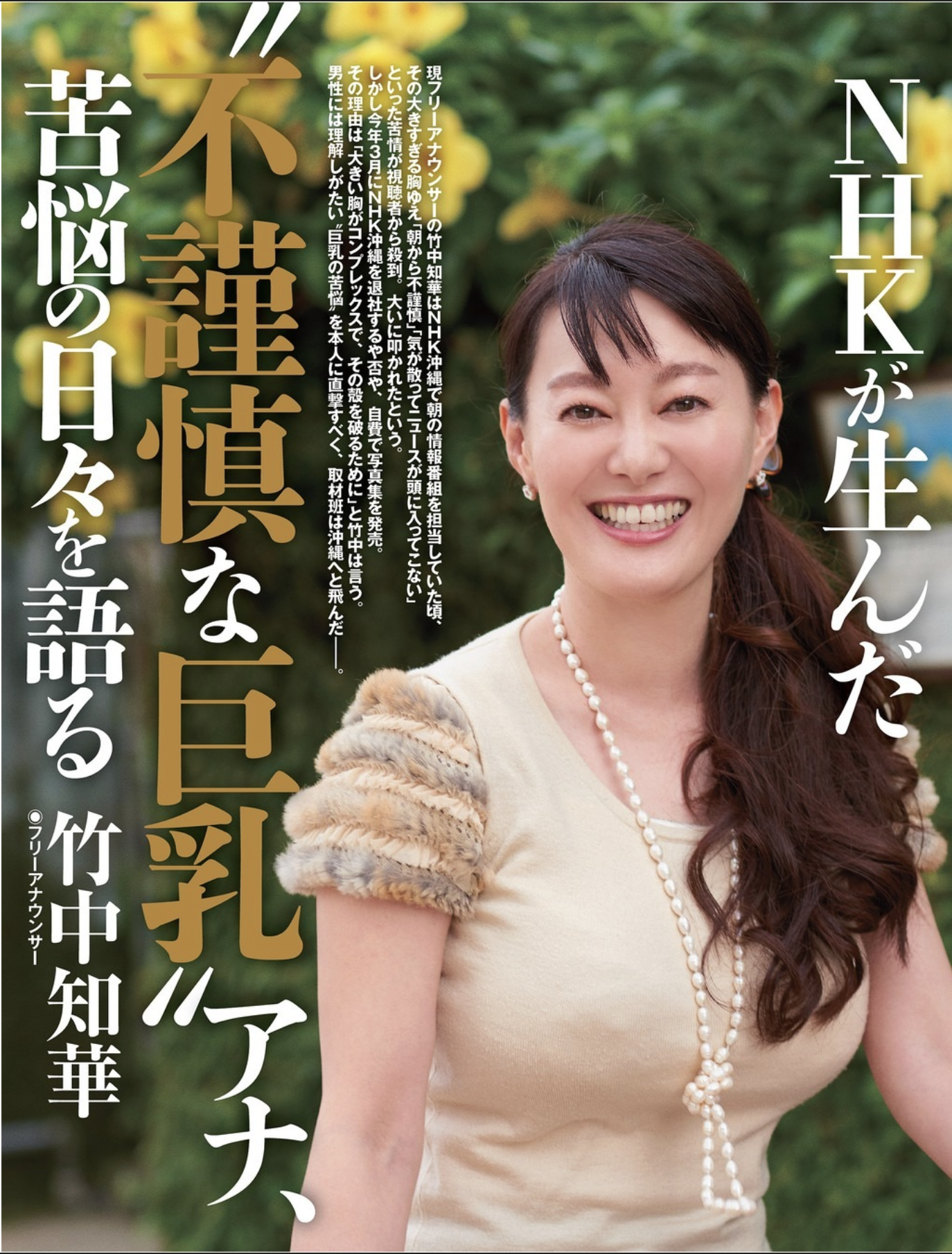
Tomoka Takenaka speaks candidly about the days of struggle
When current freelance announcer Tomoka Takenaka was in charge of a morning news program at NHK Okinawa, she was flooded with complaints from viewers such as, "Her breasts are too large, which is inappropriate," and "It's distracting; I can't focus on the news."
She was reportedly heavily criticized.
However, in March of this year, as soon as she left NHK Okinawa, she published a self-funded photo book. Takenaka says the reason was that "having large breasts was a complex, and she wanted to break out of that shell." To interview her directly about the "suffering of a large-breasted woman"—which men may find difficult to understand—our reporting team flew to Okinawa...
1. The Scene in Shuri
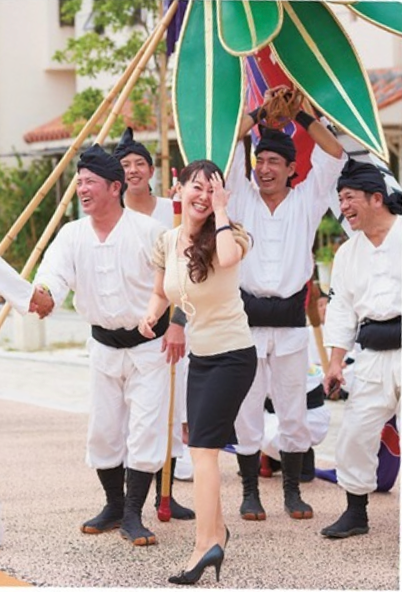
The day of the interview happened to be the day of the "Ryukyu Dynasty Festival Shuri" held at Shuri Castle. This is one of the city's three major festivals, held on Culture Day (11/3/2015), featuring a "Koshiki Gyoretsu" (traditional procession) of 3,000 people recreating a royal pilgrimage and "Kaee" (banner performances) passed down through the districts. As Announcer Takenaka walked through the festive streets for the photo shoot, she was immediately approached by locals saying, "Ah, it’s Ms. Takenaka!" "Are you on assignment?" and "Please take a photo with us."Having served as the "Morning Face" of NHK Okinawa for seven years—regularly appearing on the weekday program Ohayō Okinawa and reporting for NEWS Okinawa 610—it was evident she was deeply familiar to and beloved by the Okinawan people. We began by asking about the truth behind the "large breast controversy" (kyonyū sōdō) that suddenly engulfed her in 2011.
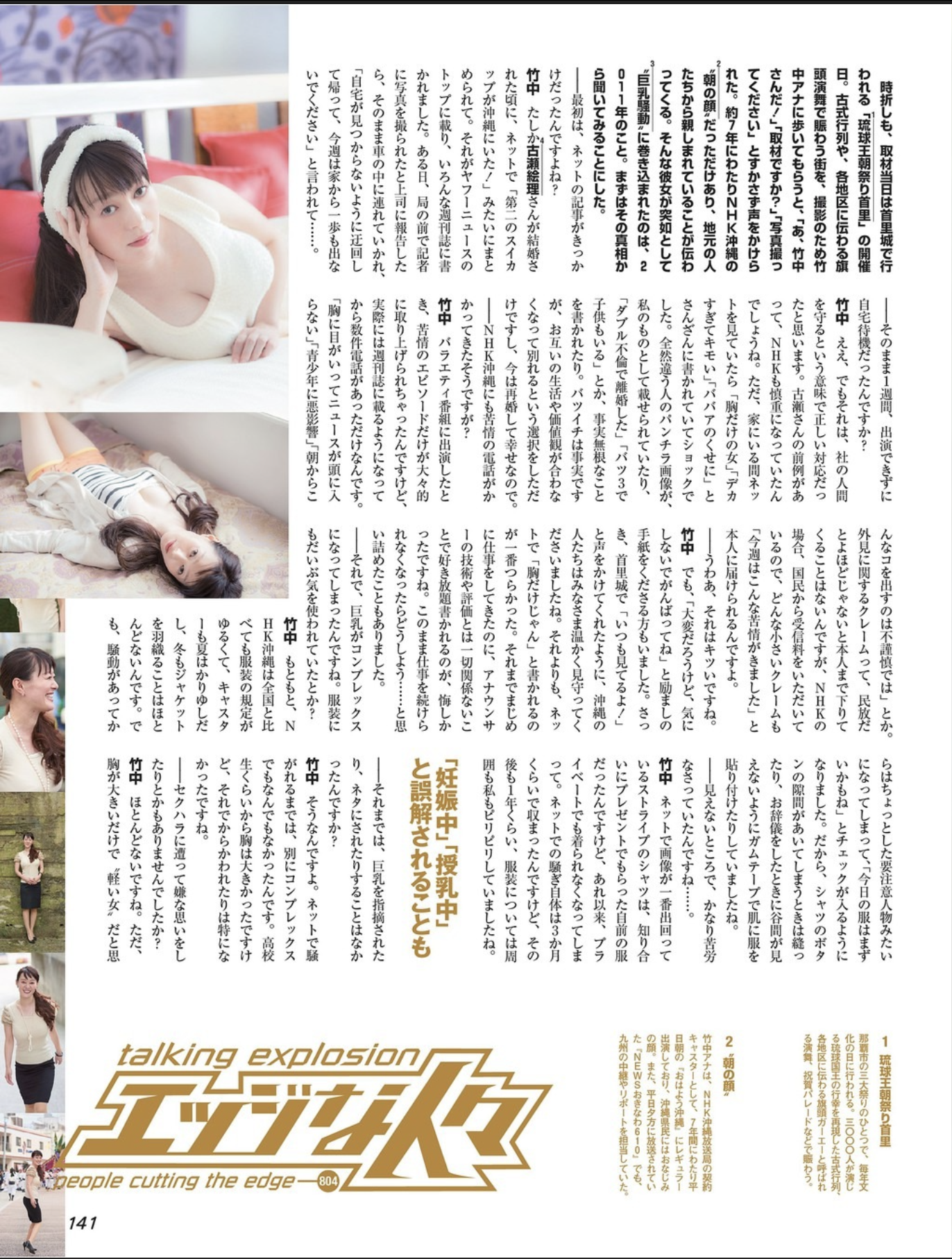
2. The Scandal and the "Second Suikap" Trigger —It all started with an internet article, didn't it?
Takenaka: I believe it was around the time Eri Furuse (the “First Suikap”) got married; the internet labeled me as “The second Suikap [Watermelon-cup] in Okinawa!” That hit the top of Yahoo! News and was picked up by various weekly magazines. One day, after a reporter took my photo in front of the station, I reported it to my boss. I was immediately rushed into a car and told, "Take a detour home so your house isn't discovered, and don't step foot outside your home at all this week".
3. Standby and the Reality of Slander
—So, you were on standby at home for a week without appearing on air? Takenaka: Yes. But I think that was the correct response in terms of the company protecting its employee. Because of the Eri Furuse precedent, NHK was likely being very cautious. However, while at home, I looked at the internet and was shocked to see things like "she’s just a woman with breasts," “they're so big it's gross," or "old hag". There were fake photos of other people's underwear posted as mine, and baseless claims like "she divorced (first marriage was in 2006) because of a double affair" or "she’s a mother of three". (she has no documented children) While the fact that I am a divorcee is true, my first husband and I simply chose to part ways because our values didn't align; I remarried a local Okinawa man and am happy now.
4. NHK’s Internal Complaints and "License Fee" Pressure
Takenaka: When I appeared on a variety show, the "complaint episode" was emphasized, but in reality, there were only a few phone calls after the weekly magazines started reporting. The complaints were things like, "I can't focus on the news because my eyes go to her chest," "a bad influence on youth," or "is it appropriate to put such a girl on in the morning?". In commercial TV, complaints about appearance rarely reach the talent, but at NHK, because we receive license fees from the public, even the smallest grievances are delivered directly to the announcer.
—That sounds incredibly draining.
Takenaka: While Okinawans gave me warm support and sent letters saying "hang in there," being told online that I was "just breasts" was the most painful part. I had worked seriously, so having people say whatever they liked about things unrelated to my skills as an announcer was frustrating. I felt so driven to the brink (omoitsumeta) that I wondered if I could even keep the job.
Her cup size, she says, fluctuates between G and H.
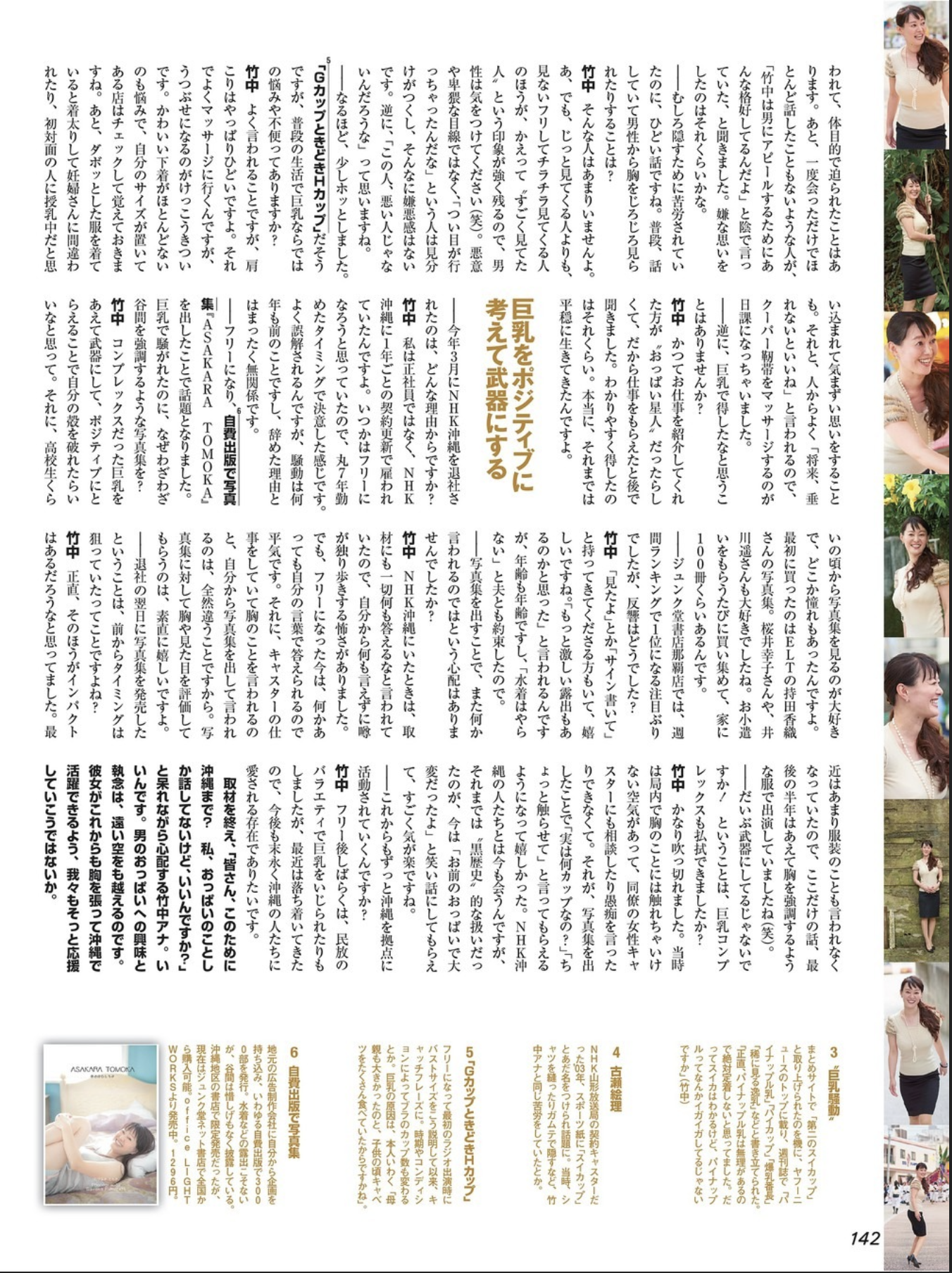
 SPA! Magazine, December 2015 — article page as published
5. Wardrobe "Measures" and Surveillance
—So, the large breasts became a complex?
Takenaka: Originally, NHK Okinawa had loose clothing regulations; casters wear kariyushi in summer and rarely wear jackets in winter. But after the uproar, I became a "person of interest" (yōchūi jinbutsu), and staff would check my clothes daily, saying "today’s outfit might be bad". I started sewing the gaps between shirt buttons shut and using duct tape (gamu tēpu) to stick the clothes to my skin so cleavage (tanima) wouldn't show when I bowed.
—You went through a lot of trouble behind the scenes.
Takenaka: The striped shirt that circulates most online was my own clothing given as a gift from a friend, but I can't even wear it privately anymore. The internet noise died down in three months, but for about a year after, both I and those around me were "on edge" (piri-piri) regarding my clothing.
6. Physical Strain, Stigma, and Daily Care
Takenaka: Until the uproar, it wasn't a complex at all. My breasts have been large since high school (G cup, sometimes H cup), but I wasn't teased. I almost never experienced sexual harassment, but I did hate the assumption that just because a woman has large breasts, she must be an "easy woman" (karui onna).
Physical Inconveniences: She suffers from shoulder stiffness and pain, difficulty finding cute bras, and the fact that certain clothes make her look bulky.
Misunderstandings: She was frequently misunderstood by strangers as being "pregnant" or "breastfeeding". I find being glanced at repeatedly more unpleasant than actually being stared at.
Daily Maintenance: Because people said things like "I hope they don't sag," massaging the Cooper's ligaments (connective tissue that maintains breast structure) has become part of her daily routine.
 SPA! Magazine, December 2015 — article page as published
7. Career Transition and the Photo Book
In March 2015, she resigned from NHK Okinawa. She was not a full-time employee but worked on yearly contracts, and she had always planned to go freelance after seven years. Upon leaving, she released the self-published photo book ASAKARA TOMOKA. She intentionally emphasized cleavage in the book, explaining: “I wanted to turn my complex into a weapon and view it positively, so I could break out of my shell.”
Takenaka clarifies that she was never a full-time NHK employee. She worked on renewable one-year contracts and always expected to go freelance eventually. After seven years, she felt the timing was right. Releasing the photo book ASAKARA TOMOKA the day after leaving NHK was intentional.
“I thought it would have more impact,” she admits. “And honestly, having my appearance evaluated positively through a photo book made me happy.” She adds that while some expected more revealing content, she had promised her husband she would not do swimwear.
After going freelance, Takenaka appeared on commercial TV variety shows, where her chest was sometimes treated as a joke. But over time, she says things settled down. At one point, she deliberately chose outfits that emphasized her figure, reframing what had once been treated as a weakness into something she could control. “The complex is gone,” she says. “Before, even my female colleagues couldn’t talk about it. After the photo book, people could finally ask openly. That felt liberating.”
Today, Takenaka works as a radio personality on Radio Okinawa and FM Okinawa, including programs such as Tokimeki Revival, Colorful, and Chura Iebana.
“I want to continue being someone loved by the people of Okinawa,” she says.